Last week we ran down some of the most prominent LGBTQ+ characters to make the leap from comic book pages to live action TV shows and films. For this week’s installment, we’re taking a look at a few others, as well as other categories including characters whose orientations were changed in adaptation, characters who were invented for the screen and characters I can only describe as “it’s complicated.”
Phastos (‘The Eternals’)
The 2022 film “The Eternals” gave us the Marvel Cinematic Universe’s first openly gay hero in Phastos (Brian Tyree Henry), the immortal super team’s resident inventor with the power to manipulate cosmic energy and instantly forge complex weapons from his designs.
The comic book version of Phastos has only had one romantic relationship of note, when he was married to a woman named Gretel during a period when he was forced to forget his superhero past. The film, however, gave Phastos a husband, Ben (no relation), and an adopted son, Jack.
Since the release of the film, Phastos’ sexual orientation has not been directly addressed in the comics, but an issue released the same year as the movie seemed to hint at past relationships, with Phastos mourning for “men I have held and time has taken from me.”
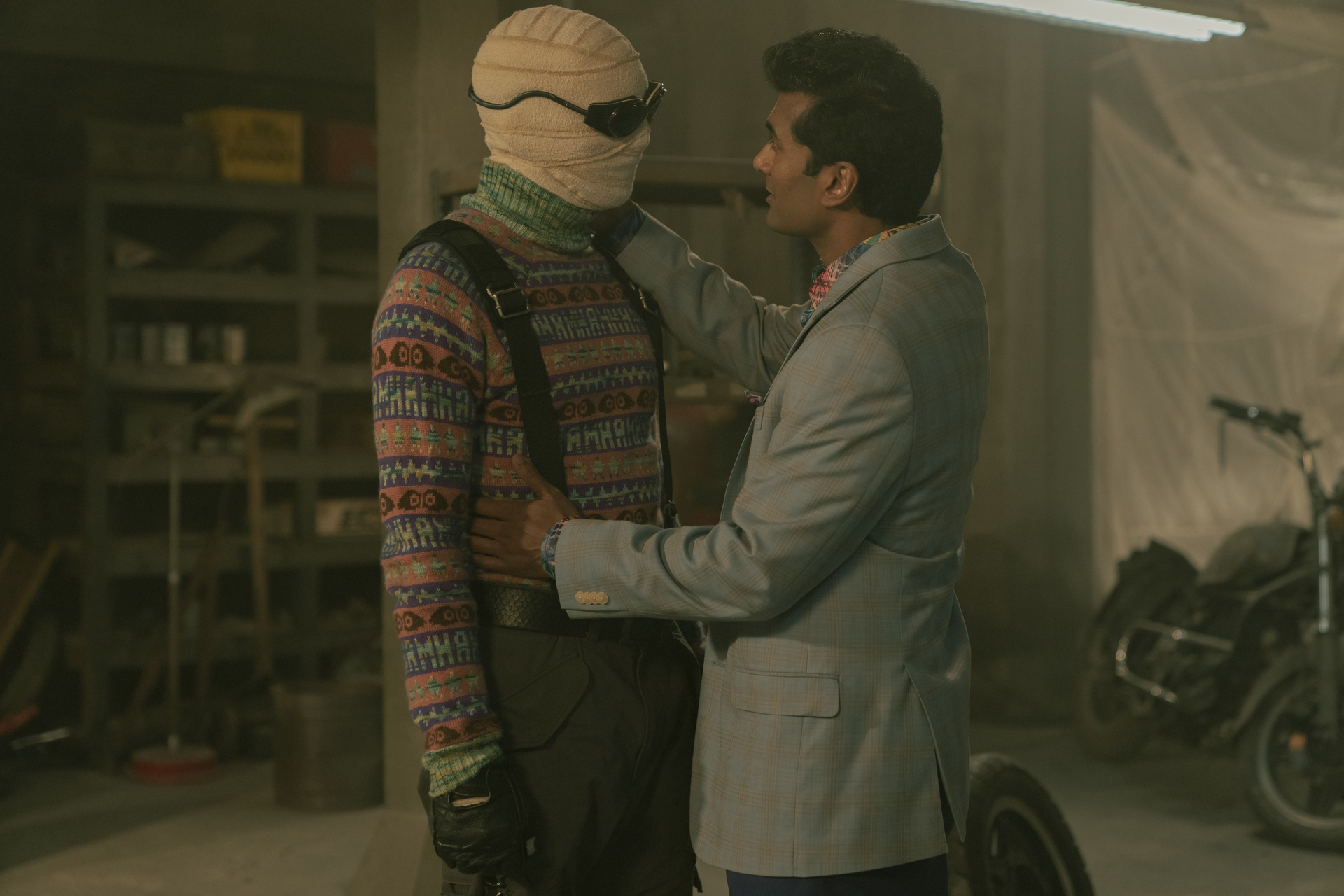
Larry Trainor, aka Negative Man (‘Doom Patrol’)
Founding Doom Patrol member Larry Trainor was a test pilot who was exposed to a radioactive field and wound up sharing his body with a “Negative Spirit” who could be released for 60 seconds at a time. Larry had to spend his life covered in specially-treated bandages to keep his radiation from infecting others.
The comics version of Larry exclusively had relationships with women–but did become intersex for a time when he and his doctor, Eleanor Poole, merged with the Negative Spirit to create the being Rebis.
The 2019-2023 “Doom Patrol” streaming series version of Larry Trainor (Matt Bomer and Matthew Zuk) gave him a backstory where he had a passionate affair with another male test pilot in the Air Force before getting married to a woman and having children due to societal pressure. His character arc in the series largely revolves around his coming to terms with both his homosexuality and his partnership with the Negative Spirit.
Joseph Wilson, aka Jericho (‘Titans’)
The sexuality of Jericho, an off-and-on member of the Teen Titans, is a bit, well… complicated. Creators Marv Wolfman and George Pérez had considered making him gay from all the way back in the 1980s, but were concerned his sensitivity, artistic side and feminine features would play too much into stereotypes. They instead portrayed him as heterosexual, with multiple female love interests.
Wolfman would later come to regret this decision, and in 2015 wrote a scene taking place in the early days of the team, where Jericho confessed in secret to a character who would be chronologically killed off shortly after (it was unclear at the time, however, whether he came out as gay or bisexual, due to Jericho being mute).
After DC’s latest continuity reboot, 2016’s “Rebirth,” Jericho was depicted as openly bisexual, having relationships with both women and men. This version would inform the live action version of the character (Chella Man) when he joined the cast of “Titans” in its 2019 second season.
Curtis Holt, aka Mr. Terrific (‘Arrow’)
As briefly mentioned in last week’s article, Mr. Terrific (Echo Kellum) became the first LGBTQ+ superhero in a DC Comics live action property when he joined the cast of “Arrow” in Season 4 (although he didn’t actually suit up as the hero until the following year). When he first appeared, he was married to Paul Holt, and after the end of their relationship he married Nick Anastas.
This was a departure from the comic books, where Curtis Holt was always portrayed as straight, and cites the death of his wife as one of the inspirations behind his becoming a superhero.
The sexual orientation of the DCU’s new Mr. Terrific (Edi Gathegi), as seen in the 2025 film “Superman,” has yet to be established.
Ray Terrill, aka The Ray (‘The Flash,’ ‘Legends of Tomorrow’)
The Ray is another unusual case. The character was straight when he first appeared in DC Comics in 1992, but was depicted as gay as of his first “Rebirth” era appearance in 2017. That same year, he appeared in episodes of “Arrow” and “Legends of Tomorrow,” played by Russell Tovey. The TV version of the character–also featured in the animated spin-off “Freedom Fighters: The Ray”–is a gay man who got his powers from a visitation by a version of himself from another universe.
Sara Lance, aka White Canary (‘Arrow,’ ‘Legends of Tomorrow’)
Sara Lance (Caity Lotz) is an original character created for the “Arrow” TV series (although she does share the White Canary moniker with unrelated characters from comics), who later went on to have a starring role in the spin-off series “Legends of Tomorrow.” She made her debut in the pilot episode of “Arrow” in 2012, and was established to be bisexual in a Season 2 episode from 2014. She went on to have relationships with both men and women across the two series.
Nia Nal, aka Dreamer (‘Supergirl’)
Nia Nal (Nicole Maines) became the first transgender superhero to be featured in live action when she made her debut in Season 4 of “Supergirl” in 2018. The character was an original creation for the TV series, but proved to be so popular with fans and creators that she was introduced to the comic book universe in 2021. Both versions were established to be ancestors of Nura Nal, aka Dream Girl, a member of the 31st Century super team Legion of Super Heroes.
Dishonorable mention
OK, fine, I guess we have to talk about Deadpool. Wade Wilson’s pansexuality has been accepted Marvel Comics canon ever since writer Gerry Duggan proclaimed him to be so during a 2013 Twitter Q&A, and “Deadpool” (2015) director Tim Miller and star Ryan Reynolds promised this aspect of the character would be reflected in the cinematic interpretation. So there you have it: both comic book and movie Deadpool are pansexual. But… are they? Are they really?
In both comics and movies, Deadpool’s romantic and sexual relationships have exclusively been with women. Both versions of the character are known to express lust for (and uncomfortably flirt with) male characters, but this has never resulted in an actual romance or sexual encounter. I don’t by any means want to minimize or erase the identities of bi and pan people who, for one reason or another, have only ever had hetero-presenting experiences, but in the case of “Deadpool,” same-sex attraction has exclusively been played for laughs. It’s more akin to frat boy humor than any real representation, and for that reason I can’t in good conscience award any brownie points.

About the author:
Ben Hooper believes society has progressed beyond the need for more “Deadpool” movies. Instead, he recommends the MCU consider introducing asexual icon Gwenpool to the films for comic relief.


Leave a Reply