
Danielle and I both took LGBTQ+ film classes in college and were traumatized during that time by bleak films where the leads were punished for their feelings or died by their own hand—or someone else’s.
It seems most LGBTQ+ adaptations made before the year 2000 ended in tragedy. As acceptance slowly (too slowly) came about and same-sex couples were able to legally marry, the TV and film world progressed as well.
Now, there are many queer stories that don’t just focus on coming out or bad reactions to coming out and do not end in death or punishment. You can read about some of those here. In addition, LGBTQ+ superheroes and villains have become more prevalent in recent years. You can read about those here and here.
It is still important to know your history—to not only see how society has changed in its perception of LGBTQ+ communities, but also how queer romance is depicted in media. So, Booked & Screened presents these eight queer book-to-screen stories.
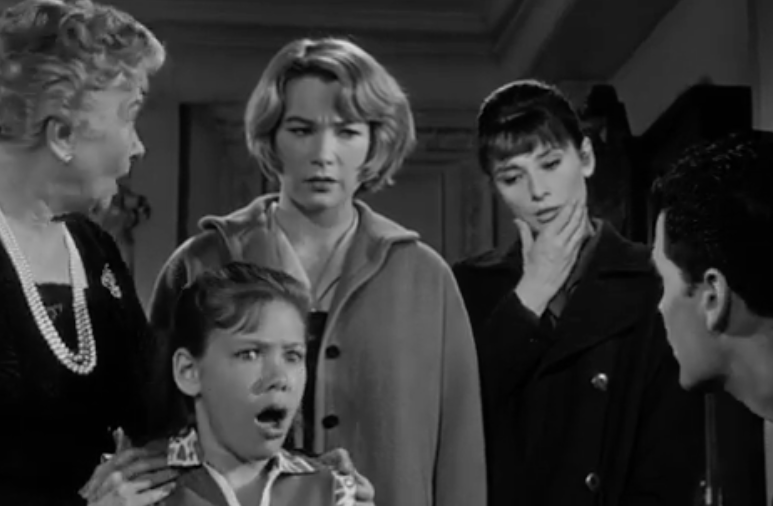
‘The Children’s Hour’ – 1961
“The Children’s Hour,” which stars Hollywood legends Audrey Hepburn, Shirley MacLaine and James Garner, was adapted from the 1934 play of the same name by Lillian Hellman. It follows Karen (Hepburn) and Martha (MacClaine), who were students together at a boarding school and grow up to start a school of their own for girls. The school is a success and life seems to be going well. After two years of being engaged, Karen agrees to a wedding date with her doctor beau, Joe. Then, a school bully named Mary starts trouble.
After overhearing Martha’s aunt accusing her of having an “unnatural” relationship with Karen, Mary starts a rumor. She tells the other students that the pair are lesbian lovers. Scandal ensues, there’s a lawsuit and the story ends in tragedy. Not surprising for a film released in 1961.
The film earned MacLaine a Best Actress in a Drama nomination for a Golden Globe and Fay Banter, in her last role, was nominated for Best Supporting Actress at the Oscars and Golden Globes that same year.
‘Brideshead Revisited’ – 1981, 2008
Based on Evelyn Waugh’s 1945 novel “Brideshead Revisited: The Sacred & Profane Memories of Captain Charles Ryder,” the story has been adapted twice—in 1981 and 2008. The story follows two decades of Charles’ life and his connection with the wealthy Flyte family, namely siblings Lord Sebastian and Lady Julia.
The story has themes of Catholicism and features gay characters. The relationship between Charles and Sebastian is complicated, and gets more so as Charles starts to fall for Julia.
The 1981 series stars Jeremy Irons and Anthony Andrews, and the 2008 film stars Matthew Goode, Ben Whishaw, Emma Thompson and Hayley Atwell. The TV series received 13 wins and 19 nominations at the 1982 BAFTA awards, two Golden Globe wins for Best Actor and Best Miniseries and several Emmy nominations, plus a win for Laurence Olivier who starred in the supporting role of Lord Marchmain.
The film received several nominations including the GLAAD Media Award for Outstanding Film in a wide release.
‘Desert Hearts’ – 1985
The 1985 film is based on Jane Rule’s 1964 lesbian novel “Desert of the Heart.” The film is known as the first movie to show a positive look at a lesbian relationship. The story takes place in 1959, when a professor, Vivian (Helen Shaver), heads to Reno to become a resident, which takes six weeks, so she can get divorced. Vivian stays at a guest house for women who are also waiting to get divorced, owned by a woman named Frances (Audrey Lindley). While there, she meets the bold Cay (Patricia Charbonneau), a sculptor and sort of stepdaughter of Frances.
The elegant, reserved Vivian at first clashes with the unapologetically free Cay. But after getting to know her more, Cay’s free-spirited nature attracts her and a romance begins.
Critics and outlets have touted the film for its passion and authenticity. It has been called groundbreaking and is featured in the Criterion Collection.
‘The Color Purple’ – 1985
Based on Alice Walker’s 1982 Pulitzer Prize-winning novel, the 1985 adaptation starred Whoopi Goldberg, Oprah Winfrey and Danny Glover. The story centers on Celie, a poor Black girl living in the South in the 1900s. Her father beats and rapes her, impregnating her with two children. Celie writes letters to God to help her pain.
The story includes several other women going through hard times, including the tough Sofia (Winfrey) and Celie’s sister Nettie (Akosua Busia). There is a romance though—between Celie and glamorous blues singer Shug Avery (Margaret Avery).
In 1986, the film earned 11 Oscar nominations, including Best Picture, Best Actress (Goldberg) and two Best Supporting Actress nominations. It tied with 1977’s “The Turning Point” as the film with the most nominations but zero wins. The book later inspired a 2005 musical, a 2008 radio serial on BBC Radio 4 and a 2023 film based on the musical starring Fantasia Barrino, Taraji P. Henson, Danielle Brooks and Colman Domingo.
‘Maurice’ – 1987
A landmark in 1980s queer cinema is the Merchant Ivory adaptation of “Maurice” based on the 1971 novel by E.M. Forster. It stars Hugh Grant as Clive, James Wilby as Maurice and Rupert Graves as Alec.
The story focuses on Maurice as he undertakes an illicit romance with Clive, an aristocrat who has a public career in politics ahead of him. Afraid of being found out for having a gay relationship, Clive ends the romance and marries a woman. After trying and failing to deny his nature, Maurice later falls in love with Alec in a romance that proves to be less tragic, though not without its own nearly disastrous moment of misunderstanding.
“Maurice” was a critical success at the Venice Film Festival, where it won Best Actor for Wilby and Grant, the Silver Lion for best director for James Ivory, and the Golden Osella for best music for Richard Robbins.
‘Fried Green Tomatoes’ – 1991
Perhaps one of the greatest—if not subtlest—sapphic love stories of the 1990s was that of Idgie (Mary Stuart Masterson) and Ruth (Mary-Louise Parker) in “Fried Green Tomatoes.” The film is an adaptation of Fannie Flagg’s novel of the same name, which is far more explicit about the romance between the two central characters. The film received backlash from some critics for downplaying their relationship, but it won the GLAAD Media Award for Outstanding Film in a wide release.
Jessica Tandy stars as Ninny, an elderly woman sharing her memories of Idgie and Ruth growing up in rural Alabama to a visitor at her nursing home, Evelyn (Kathy Bates). The story spans decades of the women’s lives as they deal with Ruth’s abusive husband and eventually start a restaurant and live their lives together. The film also stars Chris O’Donnell, Stan Shaw and Cicely Tyson.
‘Orlando’ – 1992
The fantasy-drama “Orlando,” directed by Sally Potter and starring Tilda Swinton, is a three-century-long epic exploring the themes of gender, sexuality, aristocracy and the nature of artistic pursuit. The 1992 film is an adaptation of Virginia Woolf’s 1928 novel, “Orlando: A Biography.” While it’s not a biography in a true sense—the protagonist is centuries old by the story’s conclusion—it’s been described as a love letter from Woolf to her longtime lover and fellow writer Vita Sackville-West.
The story is about a young, male nobleman in the early 17th century who is seemingly immortal and wants nothing more than to be a great poet. After some time, he metamorphoses into a woman and must navigate the world with all the restrictions put on women through history. Swinton plays Orlando in all their various ages and genders. The film also stars Billy Zane and Charlotte Valandrey as Orlando’s romantic interests, and Quentin Crisp as a cross-dressing Queen Elizabeth I.
The film was nominated for two Academy Awards—Best Art Direction and Best Costume Design—and won the BAFTA award for Best Make-Up, as well as earning Potter the European Film Award for Young European Film.
‘Tales of the City’ – 1993
The 1993 miniseries “Tales of the City” was based on a series of 10 novels written by Armistead Maupin from 1978 to 2024. The story originally started as a serial in the San Francisco Chronicle, and in addition to the TV series, it has been adapted to radio, a concert series, a sequel series on Showtime in 1998 and 2001 and a Netflix series in 2019.
The story is almost a queerer version of “Melrose Place.” It starts when Mary Ann Singleton (Laura Linney) moves from the midwest to San Francisco. She settles down at 28 Barbary Lane, whose residents and landlady Anna Madrigal (Olympia Dukakis) are all colorful, fun, eccentric and flashy. The series follows their romances, scandals and friendship. Other well-known actors, including Thomas Gibson, Billy Campbell and Parker Posey, also starred in the 1990s series.
Linney and Dukakis, among other stars, returned for the Netflix sequel series, which starred Elliot Page, Murray Bartlett and Charlie Barnett.
About the writers
S. Lynn Bonanno and Danielle Haynes are co-founders and editors of Booked & Screened.




Leave a Reply