In 1992, Canadian speedster Northstar became the first openly gay superhero in Marvel Comics—and mainstream superhero comics as a whole .
While the ranks of confirmed LGBTQ+ characters have since grown, we wouldn’t see the first openly queer hero or villain in live action (if I included animation we would be here all day) until Curtis Holt was introduced in Season 4 of the CW series “Arrow” in 2015, and suited up as Mr. Terrific at the start of the following season in 2016. Notably, this depiction was a departure from his comic book counterpart, who has exclusively been depicted as heterosexual.
While this didn’t exactly open the floodgates of representation, there has been a slow trickle, with a slowly increasing number of LGBTQ+ comic book characters appearing in TV shows and movies.
Here’s a rundown of some of the most prominent LGBTQ+ superheroes and villains to make the jump to live action.
Billy Kaplan, aka Wiccan (‘Agatha All Along’)
Wiccan (Joe Locke) was openly gay from his first appearance in Marvel’s 2005 series “Young Avengers,” and his sexuality remained intact when he made the jump to live action in the 2024 Disney+ series “Agatha All Along.”
The comics version went on to have a relationship with his teammate Teddy Altman, aka Hulkling, and the pair officially married in 2020. Whether this relationship will be reflected in the MCU remains to be seen (Hulking, where art thou).
Kate Kane, aka Batwoman (‘Batwoman’)
The modern version of Batwoman, Kate Kane, was introduced in the pages of the 2006 maxi-series “52,” where she was depicted as the ex-girlfriend of Batman ally Renee Montoya. Batwoman went on to headline her own comics, in addition to appearing in other Bat-family books.
Batwoman became the first gay superhero to headline her own TV series with the premiere of her eponymous show on The CW in 2019. Kate Kane (Ruby Rose) ended up being written out of the series after the first season, but her replacement, Ryan Wilder (a character created for the series and played by Javicia Leslie), was also depicted as a lesbian.
Karolina Dean and Nico Minoru (‘Runaways’)
The 2003Marvel series “Runaways” introduced a team of teens who struck out on their own after discovering their parents were secret supervillains known as the Pride (not the good kind of Pride). Among them was Karolina Dean (Virginia Gardner), the child of space aliens who was harboring a second secret: She likes girls.
Karolina sparks a relationship with her teammate, Nico Minoru (Lyrica Okano), who comes to terms with her own bisexuality. Karolina and Nico became the first openly LGBTQ+ Marvel characters to appear in live action when their relationship made the jump to Hulu’s “Runaways” in 2017.
John Constantine (‘Constantine,’ ‘Legends of Tomorrow’)
John Constantine, a mysterious magic man who first appeared in the pages of “Swamp Thing” in 1985, was confirmed bisexual in the pages of his own comic, “Hellblazer,” in 1992—although this would largely be ignored until 2014 (he later dates a shark man).
The 2005 film “Constantine,” starring Keanu Reeves, would not address the character’s bisexuality, nor would the 2014 NBC series of the same name, which starred Matt Ryan. However, his status as bisexual would later be confirmed when the TV series version of the character joined The CW’s “Legends of Tomorrow,” where he entered into a relationship with a man in 2018.
America Chavez (‘Doctor Strange in the Multiverse of Madness’)
America Chavez made her Marvel Comics debut in 2011, and was confirmed to be a lesbian in “Young Avengers” two years later. Fans eagerly waited to see how her sexuality would be handled when America (Xochitl Gomez) made her Marvel Cinematic Universe debut in the 2022 film “Doctor Strange in the Multiverse of Madness,” and the result was … mixed.
Like her comic book counterpart, the film version was raised by two mothers, but her own sexuality was barely alluded to. She wears a Pride Flag pin, and the words “Amor es amor” (“Love is love”) written on her jacket, but as of this writing, her lesbian status remains unconfirmed in the MCU.
Tim Drake, aka Robin (‘Titans’)
The third, and some might say best (it’s me, I’m “some”), hero to take up the mantle Robin was Tim Drake. He officially came out as bisexual in 2021, but previous writers have confirmed the subtext fans had been reading into for years was anything but accidental (DC, if you are reading this, let Tim and Conner Kent kiss, you cowards).
Tim (Jay Lycurgo) made his live-action debut in the third season of “Titans,” which streamed on the short-lived DC Universe app before moving to HBO Max. TV Tim would enter into a relationship with Bernard Fitzmartin (James Scully) in Season 4.

Jay Lycurgo stars as Tim Drake in “Titans.” Photo: HBO Max
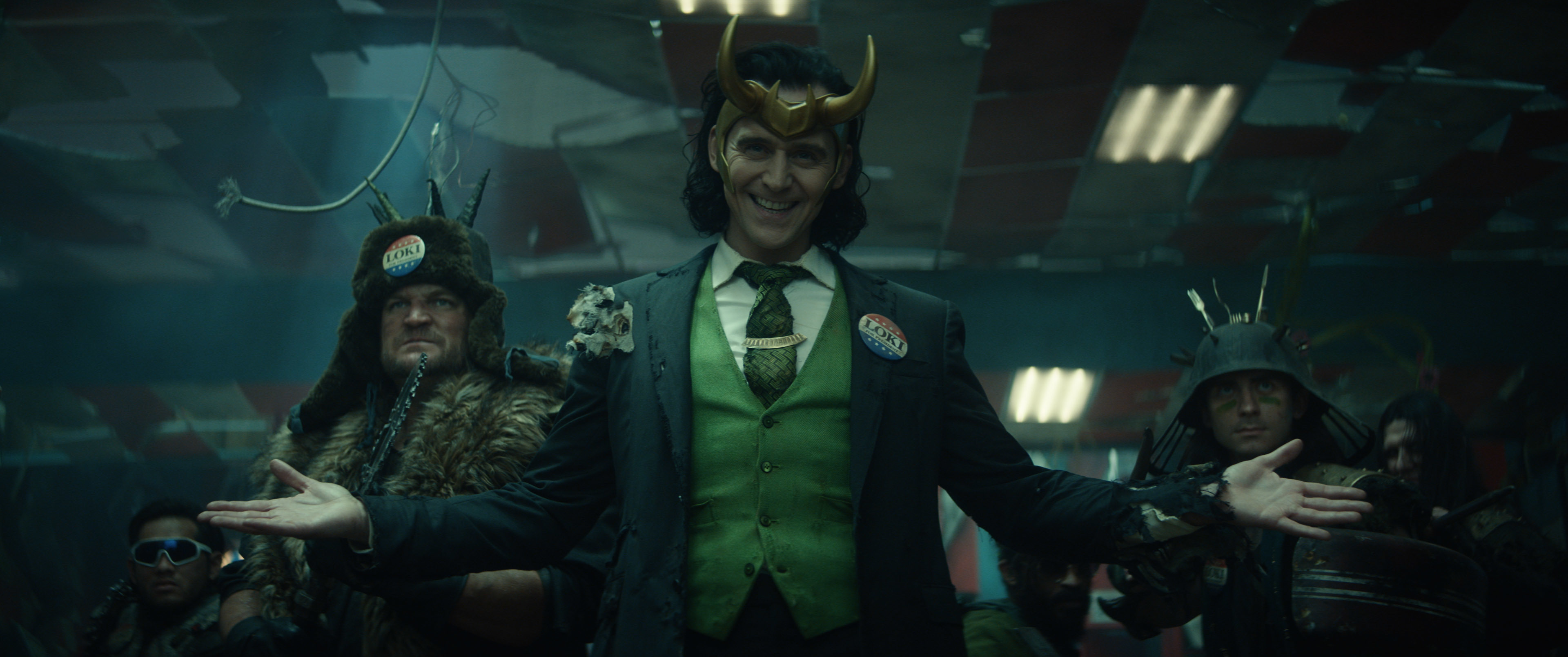
Loki (‘Loki’)
The queer history of Thor’s brother, Loki, goes all the way back to Norse mythology, which includes stories of the trickster god changing gender and even bearing children (including, but not limited to, one horse).
This aspect of the demigod’s identity was initially ignored by Marvel Comics until being resurrected in a female body in 2018. The character eventually developed the ability to change genders at will. Loki has been openly gender fluid and pansexual since 2014.
These aspects of the character went unaddressed in the MCU until the 2021 “Loki” series. Loki (Tom Hiddleston), during a conversation with his female double (Sophia Di Martino) from another timeline, responds “a bit of both” when asked if his romantic history includes “would-be princesses, or perhaps another prince.”
Loki’s relationship with gender would not be explored in the series, but a brief glimpse of his Time Variance Authority intake form during a credits sequence would list Loki’s “sex” as “fluid.”
Pamela Isley, aka Poison Ivy (‘Batwoman’)
That the first live-action version of DC villain Poison Ivy (Uma Thurman), in 1997’s “Batman & Robin,” failed to depict the character as queer is hardly surprising—she wasn’t confirmed bisexual until writers Jimmy Palmiotti and Amanda Connor outed her on Twitter in 2015.
Her romantic and sexual relationship with Harley Quinn wouldn’t be confirmed on-page until 2021 (they did share a kiss in “DC Comics: Bombshells” in 2017, but that series took place outside the main continuity).
It wasn’t until the third live-action version of Ivy (the second (played by Maggie Geha) being in the 2014 FOX series “Gotham”) that her queerness was depicted on screen. Season 3 of “Batwoman” in 2022 introduced her (played by Bridget Regan) as the on-and-off romantic interest of law-woman Renee Montoya (Victoria Cartagena). Unlike the comics, this version of Ivy was explicitly stated to be a lesbian.
Harley Quinn (‘Birds of Prey (and the Fantabulous Emancipation of One Harley Quinn)’)
While Harley Quinn (Kaley Cuoco) and Poison Ivy’s (Lake Bell) relationship forms the heart of the “Harley Quinn” animated series, the two have yet to so much as share the screen in live action.
However, Harley’s bisexuality was briefly alluded to in the 2020 DCEU film “Birds of Prey” (I’m not typing that whole title out again). During a montage of Harley (Margot Robbie) explaining her past relationship history, one of her pre-villainy flames is depicted as a woman.
Next week:
“But what,” I hear you ask, “about the Deadpool-shaped elephant in the room?” Don’t worry, we’re getting to that. Come back next week for Part 2!
About the author:
Ben Hooper grows ever more despondent with each passing Pride Month where DC refuses to allow Tim Drake and Conner Kent to be a couple. He would also like to take this opportunity to remind the creative team behind the MCU’s future X-Men projects about the existence of Escapade, a trans lesbian and former criminal with the mutant power to “switch places” with anyone she can see. Put Escapade in your movies, you cowards.

Leave a Reply