
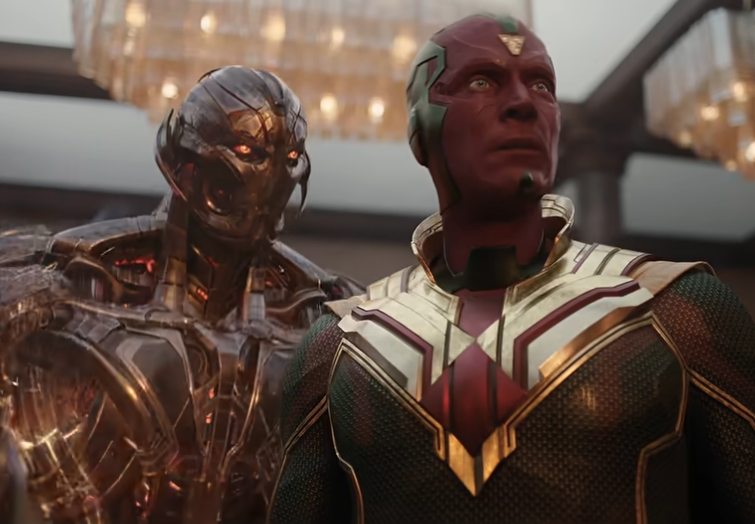
The first two episodes of “VisionQuest,” the long-awaited capper to the trilogy started by “WandaVision” and “Agatha All Along,” have finally arrived on Disney+. The results are a combination of promising and a bit concerning.
When last we saw Vision (Paul Bettany) he had been rebuilt by shadowy organization S.W.O.R.D. after his death at the hands of Thanos in “Avengers: Infinity War.” He fled for parts unknown after receiving a download of his old self’s memories from a magically-reconstituted version of himself in “WandaVision.”
In the opening episode we find our android hero struggling to connect emotionally to those past memories, working in an Edinburgh bar frequented by his former self during his relationship with the dearly-departed Wanda (Elizabeth Olsen) and spending his free time in a virtual reality he created for himself and his “family”–human avatars of the various AI programs created by Tony Stark (Robert Downey Jr.).
The most surprising inclusion (well, would be surprising if not for the trailers) is Ultron, the titular villain from “Avengers: Age of Ultron,” played in the virtual flesh by his original voice actor James Spader and kept locked away in the attic of Vision’s digital mansion. If not for Bettany’s natural charm, Spader would steal every scene he appears in with his signature combination of humor and simmering menace.
The first two episodes are at their best when we’re spending time in the colorful virtual world, getting to know the personalities and dynamics between the various AIs as they interact with one another and support Vision’s (ahem) quest to know himself better.
The episodes are at their most MCU (derogatory) in the real world, where super mercenary Paladin (Todd Stashwick) is hunting down Vision on behalf of an unknown client. No shade to Stashwick, who is always a delight to see on screen, but I’d rather “bang bang, pew pew” fight scenes didn’t interrupt my domestic sitcom about robots with personalities.
The plot truly kicks off when Vision learns Tommy, one of his magically-conjured sons from “WandaVision” survived his seeming demise by merging with a young man, Thomas Shepherd (Ruaridh Mollica), on the brink of death–the same way his other son, Billy, was revealed to have survived in “Agatha All Along” (but Vision doesn’t know about that, yet). Tommy’s arc of self-discovery promises to mirror that of his artificial father, as both men struggle to understand where they came from and their places in the world.
This is all, to various degrees, promising. So what’s concerning? The navel-gazing.
These first two episodes spend a lot of time–and I do mean a lot of time–reminding you of things writer/showrunner Terry Matalas is sure you recall affectionately. As a sequel of sorts to “WandaVision,” connections between the series are inevitable, but Matalas goes so far as to constantly revisit the most famous scenes from the previous (and notably most well-regarded) Marvel series. Remember when Vision said “What is grief, if not love persevering?” Well, you will, because Matalas shows you it again. Remember “the ship of Theseus?” Same story.
I must admit coming into this with a degree of prejudice. Matalas’ previous work on “Star Trek Picard” Season 3 was a nonstop parade of pointing at references to “Star Trek: The Next Generation” and asking the audience, “Remember this? You loved this, right?”
“VisionQuest,” at least in its initial episodes, doesn’t quite cross the line into nostalgia slop, but it edges dangerously close at several points. There are scenes of Vision sitting in his home theater and watching his own previous MCU appearances–making him the second MCU character, after Loki, to literally sit down and watch Marvel movies inside a Marvel TV show (“I would have two nickels,” etc.).
Prior series “Agatha All Along” managed to pick up plot threads from “WandaVision” and turn them into a show that could stand on its own within the MCU and tell its own satisfying story. The first two episodes of “VisionQuest” offer some hope that it can do the same, but raise just as many red flags. Only time will tell.
About the author
Ben Hooper will never, ever miss an opportunity to complain about “Picard” Season 3. Or Season 2, for that matter. Season 1 was pretty good.






Leave a Reply