
The twists are sharp drops, not slow burns. The dialogue is quick and believable. And the meet-cute? A car rental desk at a decrepit airport. Welcome to “Drive Me Mad,” Rommi’s inaugural venture into vertical romance, where the usual Hollywood apparatus of romantic aspiration has been given a rather uncomfortable ride.
Founded by entertainment industry veterans Jamie Gordon and Maggie Malina, Rommi is exploring how romance can find a new home on smartphones. The company emphasizes working with authors to develop its stories. Its inaugural production, “Drive Me Mad,” is based on an idea by romance author Ali Rosen (“Unlikely Story,” “The Slow Burn”). The film was produced with Bookish Media and content creator Morgann Book. The company is betting that stories told vertically can offer more than quick entertainment.
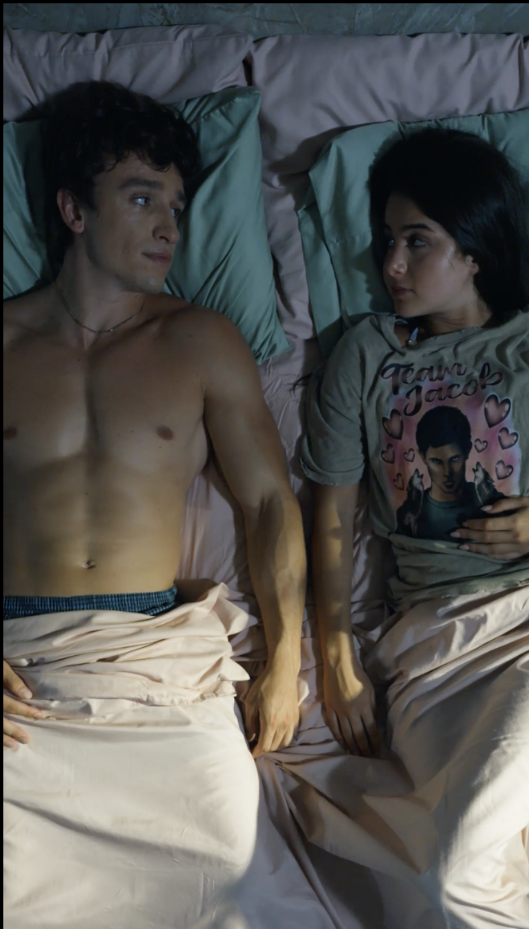
Olivia (Meg Levine) and Joe (Beau Minniear) find themselves sharing the last available rental car after an airport meltdown, with 900 miles ahead of them and the unwelcome realization that they are competing for the same client. Olivia immediately clocks Joe as her high school crush. Joe, apparently, has considerably less reliable powers of recollection.
Their romantic chemistry begins to develop as their personalities emerge during the drive. The mile markers serve as chapter breaks, turning the journey itself into a countdown.
For a film designed to be watched on a phone, this is a clever way of making physical distance do the work of narrative time.
The visual landscape belongs to a generation that grew up on Instagram, with all the influencer aesthetics that implies. Yet beneath the carefully assembled surfaces lies a rather less glamorous existence. The film catches something about the sheer exhaustion of being a 20-something who has done everything supposedly asked of them by grind culture only to discover that none of it guarantees a particularly satisfying life.
These two are exhaustion personified, and it’s little wonder that their first act of intimacy involves them—literally—sleeping together. The rivals-to-lovers plot, which pits them against each other as they compete for the same client during a 900-mile road trip, frames corporate life as a game of “Survivor.”
At the halfway point, the stakes change as Olivia and Joe begin revealing their vulnerabilities to each other. Their material world involves a beat-up rental car and a sleazy motel room, while a fumbled embrace reveals their fears about physical and emotional intimacy. The film doesn’t pretend that professional ambition and romantic longing make for an easy combination.
Making the frame misbehave
Director Chell Stephen brings an understanding of visual composition shaped in part by her work for fashion houses Fendi and Givenchy. Traditional cinematic romance depends upon horizontal space: the distance separating two people, the tentative movement towards intimacy and the possibility of retreat. The 9:16 frame has practically eliminated that space.
Olivia and Joe spend much of the film confined to a rental car, occupying a screen that barely accommodates them both. How exactly does one construct romantic tension when the characters have nowhere to go?
“I happened to get really excited by creative limitations,” Stephen told Booked & Screened.
The phone’s split-screen format is a decidedly meta device that takes the already narrow image and slices it further, challenging conventional filmmaking techniques. Here are two people occupying the same physical space while remaining separated by their own digital worlds. At one point, Olivia expects Joe not to overhear a telephone conversation conducted inches from his ear. Apparently, even forced proximity offers no guarantees of communication.
Those creative limitations are part of a larger challenge for Rommi. Gordon and Malina believe that romance can find a new audience through stories designed specifically for smartphones, without sacrificing the emotional depth that draws readers to the genre.
Why it matters to take romance seriously
Formerly responsible for scripted programming at MTV and VH1, Malina understands romance not simply as a marketable genre, but as an imaginative experience in which identification and escape are equally powerful pleasures. Romance, she suggests, permits readers to disappear into lives entirely unlike their own. She calls this its “chameleon-like quality,” and suddenly our conversation about smartphone entertainment has become something considerably more substantial.
Gordon said that Malina introduced her to romance some 18 months earlier. Gordon, a producer with decades of Hollywood experience, had a “smart-girls-don’t-read-romance” attitude.
Malina told her, “If this is your attitude, you cannot talk to this audience. They will smell it a mile away.”
“If you don’t love it, that’s cool, but don’t play with it,” she added.
Gordon has since become an avowed fan, speaking enthusiastically about the extraordinary relationship between romance authors and their readers.
“My eyes were opened to this world,” she said, describing a community whose warmth and mutual respect surprised her.
Malina calls this cultural moment the “great unshaming of romance consumption,” reflecting a broader shift in how the genre is perceived.
In “Drive Me Mad,” Olivia and Joe are navigating a world of professional competition, exhausting labor expectations and increasingly uncertain personal relationships. Sustaining even friendship within this culture of perpetual optimization is difficult, never mind navigating romantic intimacy.
And perhaps there is another reason why romance resonates so powerfully with younger audiences. Between deadlines, professional anxieties and the seemingly endless demands upon their attention, when exactly are they supposed to meet anyone?
The word I find myself returning to is yearning. We don’t give this generation sufficient credit for it.
Gordon agrees that audiences deserve considerably more respect than the industry sometimes affords them.
“I try never to underestimate an audience,” she said.
You can watch Rommi’s micromovie “Drive Me Mad” on YouTube, Instagram, TikTok and Facebook.
About the writer
Stephanie Polsky is a professor of social science and culture. When she is not writing books about visual culture, she is one of those smart girls who reads and screens romance.








Leave a Reply