
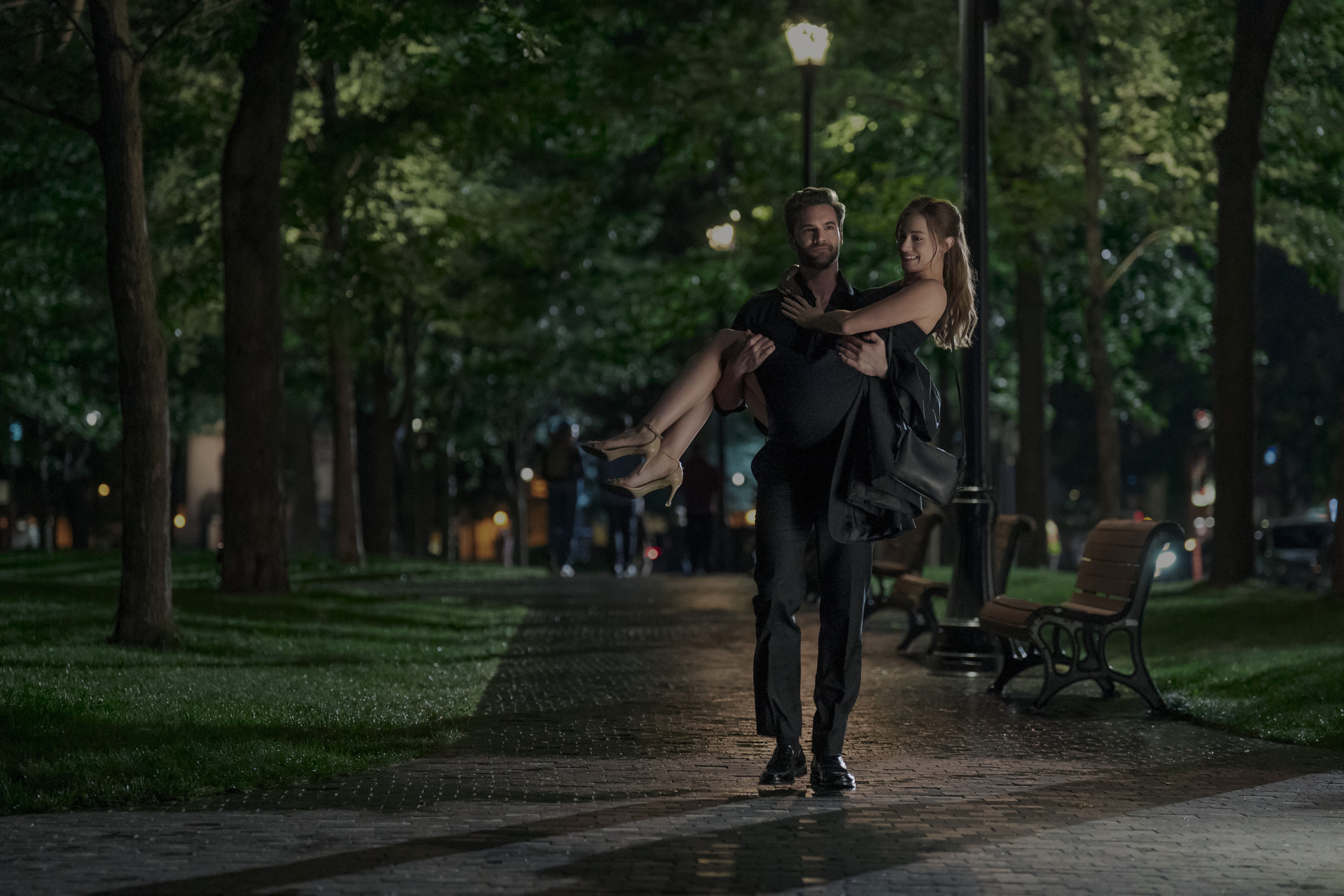
Going into “The Love Hypothesis,” an academic romantic comedy adapted from Ali Hazelwood’s enormously popular novel, I expected the usual translation problems: casting that looked slightly wrong, missing scenes, and the inevitable flattening that comes with turning interior narration into two hours of screen time. What I did not expect was to spend most of the film wondering whether anyone involved had understood why this particular romance worked in the first place.
The Love Hypothesis
Director: Claire Scanlon
★
★
★
★
1.5/5
★
★
★
★
2.5/5
The Prime Video film retains enough of the novel to remain instantly recognizable, but alters or removes so much of what gives those moments their meaning that the resemblance becomes increasingly peculiar. It looks like “The Love Hypothesis.” It rarely feels like it.
In Hazelwood’s novel, Lili Reinhart stars as 26-year-old graduate student and Stanford Ph.D. candidate Olive Smith and Tom Bateman stars as aloof 34-year-old professor Dr. Adam Carlsen. Reinhart is 30 and Bateman is 37. These age differences show on screen. Reinhart and the supporting cast are styled in bright, youthful student attire, while Bateman’s mature styling makes him look like the only grown man in a sea of college kids. But they also look too old for this dynamic, as peers in their 30s.
In the novel, Adam has messy dark hair and is repeatedly described as a brooding, broad-shouldered “mountain of a man.” Bateman is tall, but manicured and polished. That completely kills the vibe of a romantic lead. Adam’s appeal relies on his deep, quiet, commanding presence. Bateman’s tense, nasal register strips away the natural gravel and warmth and turns what should be effortless banter into a stressful pronunciation exercise.
A similar thing can be said of Reinhart. Book Olive is a severely underfunded, exhausted PhD student who hoards free department pastries and expired food just to eat. She wears oversized, faded clothes and completely unstyled hair. Reinhart has a masterpiece of a blowout, perfect makeup while working with her mice, and a polished version of student dress. Her tiny skirt becomes a recurring character. Not neo-grunge. Neo Kohl’s Juniors Department.
The film does retain the memorable flashback where a blurry-eyed Olive, who cannot afford new contact lenses, wears horribly expired ones. They begin burning before her Stanford interview, so she rips them out and cannot see Adam when he walks into the bathroom. Olive says, “Contacts are not cheap,” and Adam replies, “Neither are eyes.” The film changes eyes to corneas. When eyes become corneas, he goes full robot.
The blindness matters because Olive meets Adam without knowing who he is. He sees her before she can see him, or herself, clearly. The film keeps the scene while scraping away much of the poverty that gives it weight.
A huge part of the book’s charm is the agonizingly slow burn, weighed down by Olive’s laboratory research and funding struggles. The film condenses this academic world to get to the romance faster. We see remarkably little science beyond mice, a paper and its presentation. It even invents a science-themed party game. More strangely, Adam helping Olive prepare her paper is followed by karaoke. The intellectual intimacy is there for a moment, and then the film wanders off to do rom-com.
In the book, Olive’s journey from asexuality to demisexuality is part of the romance itself. She only experiences sexual attraction after forming a deep, trust-based emotional bond with Adam. On screen, this undergoes a bizarre heteronormative course correction. The situation is further aggravated by the use of queer authority to make Olive’s own sexual legibility apparent to her. Her roommate Malcolm (Jaboukie Young-White), portrayed as an out gay man, explains to Olive what demisexuality is. She struggles to follow him, and he laughs at her. Reinhart, meanwhile, portrays Olive’s demisexuality as sexual innocence rather than as a particular way of experiencing attraction.
So consider for a moment that this is a novel about a demisexual woman falling in love with a man with autism spectrum disorder. Adam relies on strict schedules, direct communication and explicit rules. A fake dating contract is almost the ideal foundation for them. It removes the unwritten rules of dating for Adam and the expectation of immediate physical intimacy for Olive. Neither character has to change who they fundamentally are to be loved.
At the Boston conference, the film finally moves Olive and Adam toward physical intimacy, but the chemistry still feels oddly muted. Much of the book’s consent language survives. Adam asks if she is sure, asks permission and repeatedly checks that she is comfortable.
Then “Ride It Like a Cowboy” starts playing in the background.
Of course it does.
Approximately two minutes later, Chapter 16 is over.
Except there are no feelings.
More troubling is what the adaptation has done to the events around the scene. In Hazelwood’s novel, professional and sexual coercion from a professor comes before Olive and Adam sleep together. Adam recognizes that something is wrong, affirms her scientific work and shares his experience with an abusive doctoral supervisor. Care produces trust. Trust makes sexual intimacy possible.
The film rearranges those events, which is grossly off-kilter with the girl power sequences that follow.
Apparently academic sexual harassment can be solved by a supportive woman, an angry boyfriend and an Instagram exposure.
This is neoliberal girl power with a laboratory coat.
The problem is more interesting than visible diversity. These characters work for Olive. Her best friend Anh (Rachel Marsh) interprets Adam and encourages Olive. Malcolm explains Olive’s sexuality to her. Malcolm gets a professional crisis of his own, only to conclude that he lacked passion and did not know what he wanted.
But Olive does.
I am the screw-up, not the system.
Olive gets the language of unhealthy environments, boundaries and self-determination. Malcolm gets personal deficiency. Anh gets Olive her man. Olive tells Anh she loves her and would do anything for her, but what she actually does for Anh and Malcolm is harder to identify.
Olive always wins.
By the film’s final stretch, the precarity, uncertainty and institutional ugliness have receded.
Even the wardrobe has completed its journey.
The girls are now fully J.Crew.
J.Crew has achieved tenure.
For the generation coming of age with autism spectrum disorder and demisexuality as part of the ordinary vocabulary of human identity, these are not quirky subplots or checkboxes. Nor is broke graduate student life simply atmosphere. They are part of the social and material reality through which these characters become recognizable.
Their anger does not come from Hollywood failing to include a special interest story. It comes from Hollywood actively erasing their normal.
What happens when a risk-averse Hollywood machine tries to sell an outdated version of aspiration to a generation that values authenticity, material reality and casual inclusivity above all else?
They don’t want to see a glossy fantasy. They want to see themselves recognized as real.
About the writer
Stephanie Polsky is an enthusiastic writer and sometimes reluctant reader of the zeitgeist.



Leave a Reply