
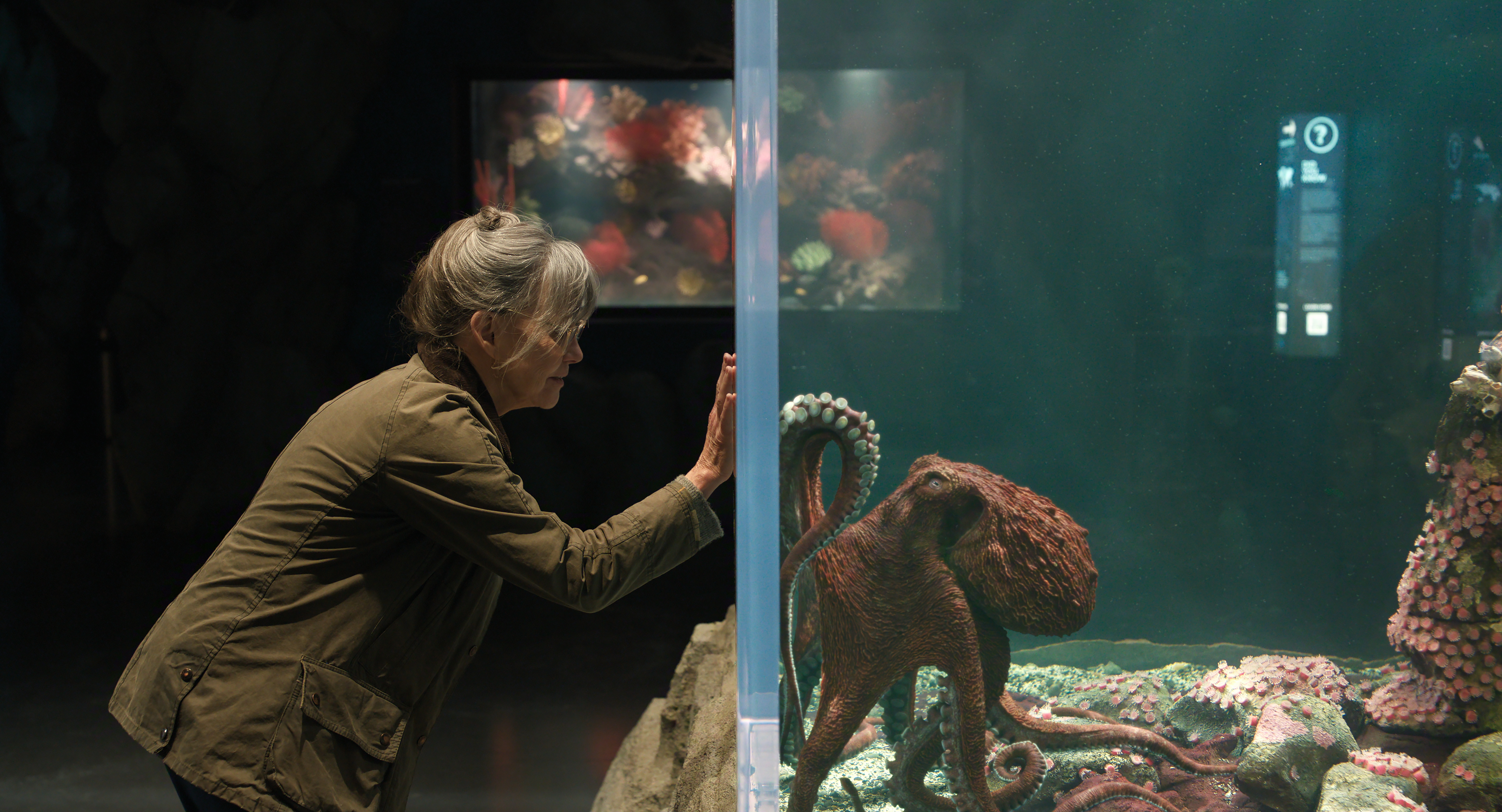
The film adaptation of Shelby Van Pelt’s novel “Remarkably Bright Creatures,” from director and co-writer Olivia Newman (who previously adapted “Where the Crawdads Sing“), takes its source material as gospel, rather than mere inspiration. Tova (Sally Field), the charming curmudgeon of a widow who works as the night cleaner at the Sowell Bay Aquarium, and Cameron (Lewis Pullman), the vaguely-30ish unemployed musician who comes to town in search of his long-lost father, may as well have been lifted directly off the page.
Remarkably Bright Creatures
Director: Olivia Newman
★
★
★
★
3.5
★
★
★
★
4.5
Field is very much in her element as a woman whose desire to keep everyone at arm’s length results from the traumatic loss of her son in what she believes to have been a sailing accident (some local rumors say otherwise), and the more recent loss of her husband from illness. Pullman, meanwhile, draws on the same lovable loser energy that made him the standout star of last year’s Marvel movie “Thunderbolts*.” The actors have an electric chemistry that makes their journey from immediate dislike to unlikely friendship not just believable, but a joy to watch unfold. In the hands of lesser performers, the film could have easily become unpalatably saccachine.
The supporting cast is filled with a who’s who of reliable character actors. Tova’s knitting club, the “Knitwits,” includes Kathy Baker, Joan Chen and Beth Grant. The effortlessly charming Colm Meaney (Chief Miles O’Brien of “Star Trek: Deep Space Nine”) plays Ethan, a shopkeeper and lifelong Deadhead who quickly befriends Cameron and harbors feelings for Tova. Sofia Black-D’Elia (“Single Drunk Female”) plays Avery, a local paddleboard shop owner who captures Cameron’s affections. The supporting characters are likable and well-cast, but unfortunately under-utilized—a tragic if somewhat understandable side-effect of the film’s laser-focus on the connection between Tova and Cameron.
The breakout star of the book—and, ostensibly, the film—is Marcellus, a giant Pacific octopus nearing the end of his life at the aquarium and pining for his home in the Pacific Ocean. In the book, the highly intelligent cephalopod is given his own chapters in which to gripe about noisy children and make observations about the people around him, and Newman makes the intelligent choice to instead cast him as a semi-omniscient narrator for the lives of his only friend, Tova, and her substitute cleaner, Cameron. His voice is provided by Alfred Molina, who apparently can’t escape being typecast as a hyper-intelligent octopus (this joke makes sense if you remember 2004’s “Spider-Man 2“). Molina imbues Marcellus with the perfect amounts of dry wit and condescension.
It is Marcellus who, I’m sorry to say, is the target of my harshest criticism. The design of the CGI octopus is gorgeous, and absolutely works—provided he is the only thing on screen at the time. The film’s insistence on every scene being absurdly brightly lit (a hallmark of Netflix films) makes the seams impossible to ignore. Whenever Tova and Cameron are interacting with the octopus—and especially when they make physical contact with him—it’s distractingly clear they are not occupying the same physical space, to the point where Marcellus starts to occupy some sort of uncanny mollusk valley. It’s unfortunate to have some moments that would have otherwise been strikingly emotional be undercut by wondering what, exactly, Sally Field was actually looking at on set. It’s unfortunate, also, to note that this could have been avoided by a simple dimming of the lights.
The cinematography overall is bland and uninspired, which is disappointing given the gorgeous real locations (that’s right, a streaming movie without Volume walls, it’s a miracle) the film is set in. We get occasional glimpses of the beauty of the Sowell Bay area—particularly in a scene where Avery teaches Cameron to paddleboard—but I can’t help but wonder what a more deft visual stylist could have done with the scenery.
The script, by Newman and John Whittington, maintains the spirit and tone of Van Pelt’s book, but, in typical direct-to-streaming fashion, doesn’t seem to trust its audience. Marcellus’ voice-over observations are often used to tell, rather than show, the struggles and feelings of the people who surround him. This approach also takes the ending of the book, which slowly comes into focus over the course of the story, and telegraphs it from a nautical mile away.
Book purists might also note some significant omissions from the film, including Tova’s brother and Cameron’s aunt, but for the sake of streamlining the story for the screen, I can’t argue with the decision.
Taken as a whole, “Remarkably Bright Creatures” is a cozy, heartfelt film for the whole family (assuming your family is OK with liberal use of the s-word). The production might hew closer to a big-budget Hallmark movie than a typical awards season dramedy, but for a straight-to-Netflix film, that’s practically a compliment.
About the writer
Ben Hooper got such a rush from typing out “Star Trek: Deep Space Nine” that he decided to do it again in his author bio. He just really likes that show.




Leave a Reply