
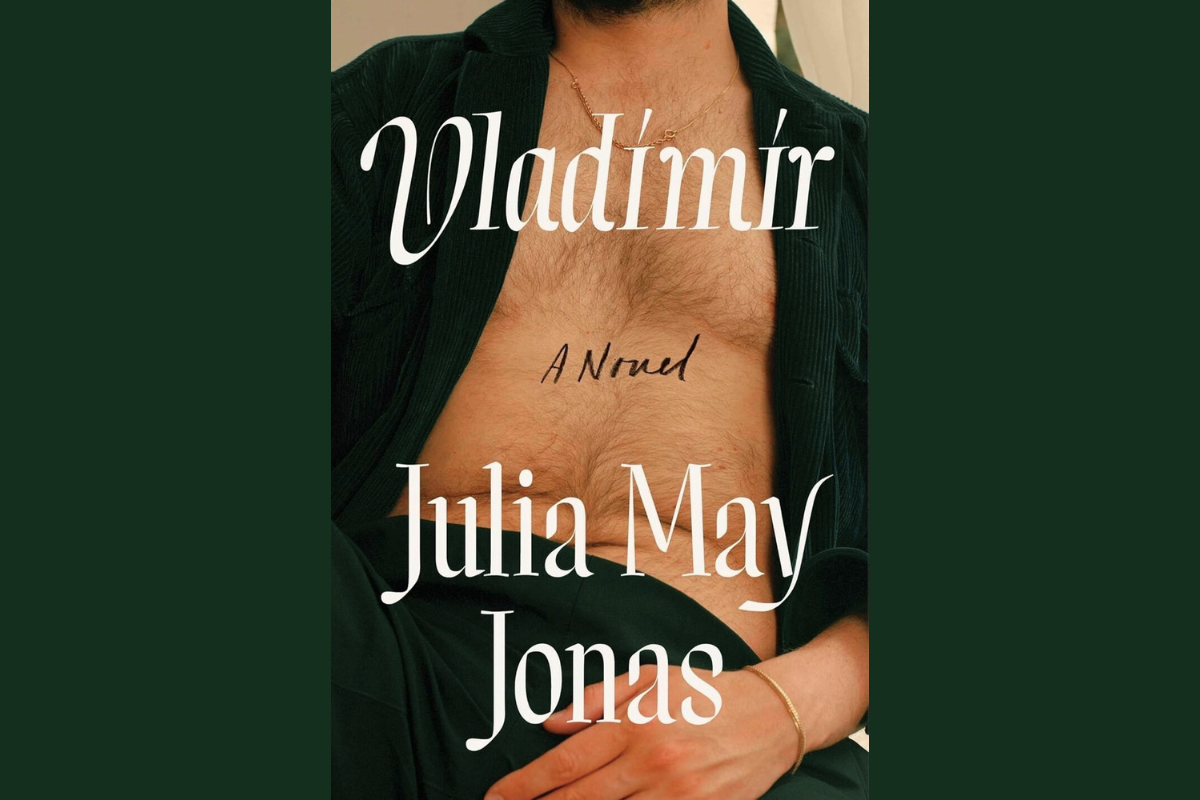
“Vladimir” is a Netflix adaptation of Julia May Jonas’s 2022 pandemic-written debut novel of the same name.
Looking at its saucy book cover—featuring the gold-chained neck and shirtless torso of a young white man wearing a dark green velour tracksuit—one immediately wonders how the series, later billed as an American television comedy-drama limited series, will straddle dark academia and sexual politics. Jonas herself is an American academic, aged 45, who teaches playwriting at Skidmore College, a small New York university, so perhaps, as they say, you write what you know.
Jonas says that “given everything that is happening to her when the novel takes place, the cruelty of aging as a woman in this society weighs heavily on her mind and plays very much into her actions.” She adds that she “enjoyed writing about a woman, no longer young, who is still exploring her relationship to ambition. And lastly, “the fact that she is an English professor allowed me to make many references and allusions to other works of literature that are dear to me while still staying true to her voice.”
Jonas’s book title is, of course, a nod to the only “Vladimir,” who reigns supreme in the literary scene, Vladimir Nabokov, and, not coincidentally, her protagonist, the “Narrator (Unnamed)” comes across as an aspiring “Humbert Humbertina.” In the prologue she said, “I often feel that perhaps I am an old man…completely guided by a sense of wanting and getting.”
One can’t help but think that the Narrator’s “unnamed voice” may be Jonas’s own, expressed through her ambitions to become a tenured professor and renowned novelist. There’s also her secret desire to heap condescension on her institution’s “Lolitas” and their accusations of sexual impropriety, as evidence of their “lack of self-regard” or a lack of their own confidence … as powerful, sexual women interested in engaging in a bit of danger, a little bit of taboo, a little bit of fun.”
This versus her unenviable position as an “oldish white woman in her late 50s (the identity I am burdened with publicly presenting to my general embarrassment).” She is five years younger than her husband who, at 63, bears no such burden.
The Narrator says the students’ complaints leave her “depressed” and annoyed that they felt “so guilty about their encounters with [her] husband that they decided he was taking advantage of them.” Mirthfully, she says, “I want to throw them a Slut Walk and let them know that when they’re sad, it’s probably not because of the sex they had and more because they spend too much time on the internet, wondering what people think of them.”
In retrospect, she only wishes she’d had the confidence to make overtures to her older male professors when she was younger.
Here’s our Narrator’s dismissive initial take on the situation:
“At one point we would have called these affairs consensual, for they were. … Now, however, young women have apparently lost all agency in romantic entanglements. Now my husband was abusing his power, never mind that power is the reason they desired him in the first place.”
This theme of sexual power continues when the object of the Narrator’s attraction, Vladimir, enters the scene of her home at the start of the semester.
In an attempt to establish intimacy with him, the Narrator, divulges “everything” to him: that she and her husband had an agreement to be as sexually free as they liked in their marriage; that he has sex with a new crop of young and fervent women every fall; that in her 20s and 30s she had affairs, the first of which was with a 21-year-old student, the most serious of which was with a colleague in the department, and that when he rejected the idea of running away with her, it was so crushing that she embraced abstinence and devoted herself to her writing career and to publishing her second novel.
Vladimir, rather than being turned on by this, looked pained and dismayed to learn that she knew of her husband’s “multiple affairs with students.” She quickly corrects him, “Multiple affairs. What silly wording. He fucked them and they fucked him. He fucked their shining skin and their panties got wet from his approval. They liked it and he couldn’t help it”.
When Vladimir winces at this remark, she considers him a “prude,” noting that “he seemed vegan. I liked it.” She then likens him to “a perturbed teenager” and fantasizes that he is so vexed by her moral indiscretions that “he uses his large, rough hands to hold her hair firmly back from her face” and commence their affair right there and then.
Just days later, when she sees his toned body unveiled for the first time at her backyard pool, “his arms muscular, his chest firm and hirsute, his stomach flat and toned”, it’s not just she, but her husband, John, who appeared to be turned on by Vladimir, a self-described “Russian nerd who started weightlifting in high school PE and never stopped.”
John then baits the Narrator further by telling her that he and Vladimir had already gone out together. Vladimir, apparently, was stringing them both along. This is hardly how we might picture an American male academic in his early 40s.
In the series, that trick of the light comes down to casting. The actor playing Vladimir, Leo Woodall, is 29 and English. Woodall had his breakout role in another Netflix adaptation, David Nicholls’s novel “One Day”(2024), in which he played the privileged, narcissistic, and hedonistic young male character, Dexter Mayhew.
Given this billing, he was quickly snatched up the following year to play Bridget Jones’s (Renée Zellweger) much younger, brazen new love interest, improbably named “Roxster McDuff,” in “Bridget Jones: Mad About the Boy.” The fictional character Roxster is 29, while Bridget is 50, making their age gap 23 years, roughly mirroring the age gap in Vladimir between a 58-year-old English professor and novelist, “The Narrator (Unnamed),” and a new, young faculty member in his early 40s, equally improbably named “Vladimir Vladminski.”
When the two meet, The Narrator is navigating her husband’s on-campus sex scandal, involving sleeping with younger female students, and her own creative crisis as a writer. Vladimir, as it turns out, makes good “fodder.”
In this role, Woodall’s hot park ranger “Roxster” has aged into the hot professor “Vladimir.” Not to be outdone by Renée Zellweger’s ageless beauty, Rachel Weisz, also 55, takes on the role of the cougar to Woodall’s cub. Her dangerous infatuation with him becomes the meat of this intergenerational sandwich. The catch of the novel is that while her husband’s dalliances are all too real, her desire, obsession, sexuality, and lust are kept (mostly) within the confines of her imagination. The series trailer teases by imagining those hot flashes comically leaving the pan, and these two romantically firing off.
Next week, our writer reviews the Netflix adaptation and whether it captures the novel’s unsettling edge.
About the writer
Stephanie Polsky, like our unnamed narrator, is a middle-aged female professor at a small New York university, which shall remain nameless. No male colleagues of a similar age were consulted, nor were students harassed in the writing of this article.



Leave a Reply