
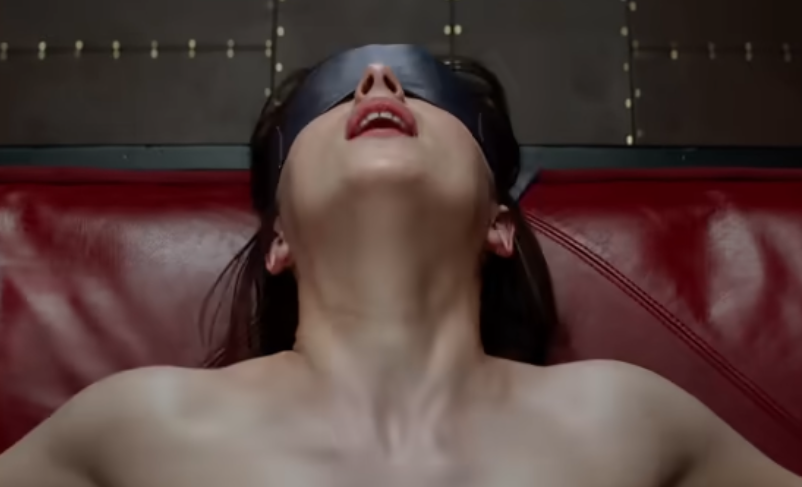
The three “Fifty Shades of Grey” films leave Netflix on June 1, marking the latest streaming shuffle for one of the wildest adaptation success stories of the 2010s.
Long before Dakota Johnson and Jamie Dornan brought Ana and Christian to theaters, E.L. James’ blockbuster romance series began as “Twilight” fan fiction posted online under the title “Master of the Universe.”
Love it or hate it, “Fifty Shades of Grey” had a massive impact on popular culture, romance publishing and fan fiction communities.
The U.K. writer’s characters Ana and Christian were inspired by Bella Swan and Edward Cullen from Stephenie Meyer’s “Twilight” series. James told USA Today that after watching “Twilight,” she read all the novels in five days and became “completely consumed by the story.”
“I thought it was masterfully told,” James said. “I’d always wanted to write … then I discovered fan fiction and I (thought), this is marvelous. I’ll have a go at this, and then I started writing what would eventually become ‘Fifty Shades.’”
Her story, “Master of the Universe,” written under the pen name Snowqueens Icedragon, attracted a massive online following. The descriptions of Ana and Christian closely mirrored Bella and Edward, while supporting characters were inspired by the Cullen family, Bella’s father Charlie and Jacob Black.
As the story gained popularity online, James eventually reworked the characters and transformed the project into the “Fifty Shades of Grey” we know today.
Published between 2011 and 2012, the trilogy follows college student Anastasia Steele and wealthy businessman Christian Grey as they enter an intense relationship shaped by Christian’s need for control and his troubled past. “Fifty Shades Darker” explores Christian’s emotional baggage and past relationships, while “Fifty Shades Freed” follows the pair into marriage, jealousy and new threats.
James also published three books from Christian’s point of view: “Grey” (2015), “Darker” (2017) and “Freed” (2021).
‘Mommy porn’ takes off
Critics mocked the writing, late night hosts and “Saturday Night Live” turned the books into punchlines and members of the BDSM community criticized the series’ depiction of consent. None of it slowed the franchise down.
Readers gobbled up the books in public, on Kindles, in office break rooms and at book clubs, helping turn “Fifty Shades” into a publishing juggernaut.
The “Fifty Shades of Grey” books gained popularity, not from ads, or a famous author, but through word-of-mouth. Middle-aged women were enticed by the tale of a handsome billionaire taking control of a naïve but intelligent woman and introducing her to his “red room.”
For many, it was an introduction to erotica, but for others, it gave their years-long love of sexy tales a new legitimacy. Of course, copycats emerged as the hunger for seductive stories became evident.
The books became New York Times bestsellers and a bidding war ensued over the rights to adapt them. Between 2011 and 2015, the phrase “mommy porn” was everywhere.
The numbers back it up: More than 150 million copies of the series have been sold worldwide.
The move to screen
More controversy followed during the film’s casting. Several actors were in the running for the role of Christian Grey, but Charlie Hunnam was eventually cast. At the time, relatively unknown actor Dakota Johnson, daughter of Melanie Griffith and Don Johnson, was cast as Anastasia Steele. Readers were divided about the casting, some creating petitions to recast the roles with Matt Bomer and Alexis Bledel.
Hunnam had to pull out of the role a month later due to scheduling conflicts with his roles in “Sons of Anarchy” and “Crimson Peak.”
“Oh, it was the worst professional experience of my life. It was the most emotionally destructive and difficult thing that I’ve ever had to deal with professionally,” he told V magazine in 2013, as reported by Variety.
Jamie Dornan was then cast as Christian, which didn’t appease the fans either. He had a lot of celebrity support behind him and, eventually, the fans accepted him. The first film, though panned by critics, was a box office success.
In fact, the trilogy of “Fifty Shades” films combined grossed over $1.3 billion.
Female fandoms explode
The book’s commercial success added legitimacy to fan fiction and changed conversations around romance publishing.
Streamers and film companies searched for built-in fandoms and adaptable online communities.
Without “Fifty Shades of Grey,” there likely wouldn’t have been the “After” franchise by author Anna Todd, which also grew from online fan fiction.
The success of fan-driven publishing also helped pave the way for books like “The Love Hypothesis” by Ali Hazelwood, which began as Reylo fan fiction inspired by “Star Wars” characters Kylo Ren and Rey and is now being adapted into a Prime Video film starring Lili Reinhart and Tom Bateman.
In addition, we wouldn’t have the hit film series “The Kissing Booth,” which started on the fan fiction site Wattpad by author Beth Reekles, then published as books and adapted into a film trilogy starring then-rising stars Joey King and Jacob Elordi.
Romance adaptations are now more commercially viable than they’ve been in years.
Whatever critics thought of the writing, “Fifty Shades” permanently changed the relationship between fandom, publishing and Hollywood adaptation culture.
The “Fifty Shades of Grey” films are available to stream on Peacock, Tubi and to rent on Prime Video and Apple TV.
About the writer
S. Lynn Bonanno respects the hustle of E.L. James and supports women reading whatever they want. She never liked Christian Grey or Ana Steele, however, because controlling behavior and naïveté are two of her least favorite traits.

Leave a Reply