
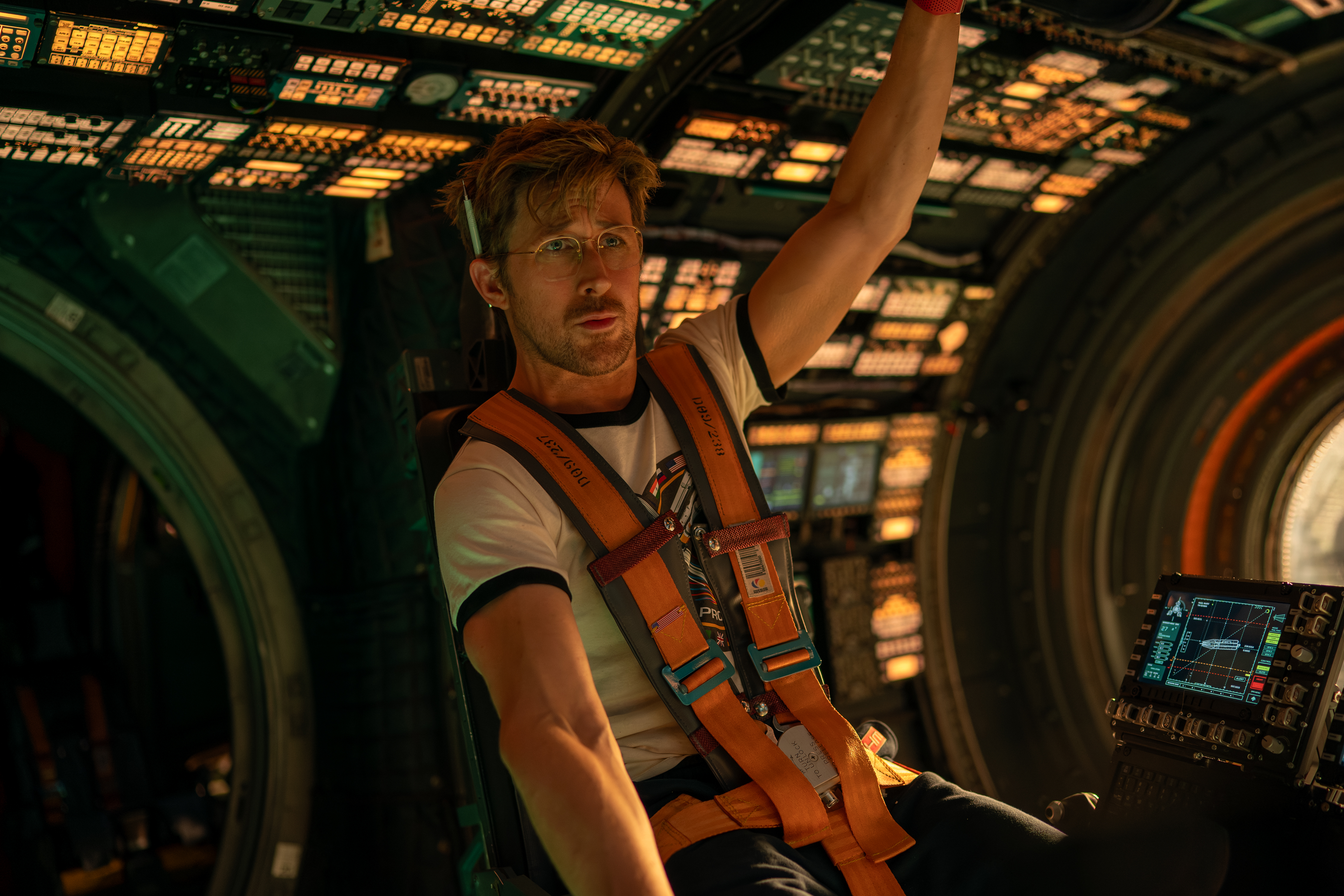
“Project Hail Mary” is a type of film that’s become increasingly rare in today’s cinema landscape—equal parts visually stunning, emotionally affecting, thematically resonant and filled with thought-provoking science fiction concepts.
The film opens with Ryland Grace (Ryan Gosling), a molecular biologist-turned-middle school science teacher, waking from an induced coma aboard a space ship light years from earth, with no memory of how he got there. Grace’s exploits in space are interspersed with flashbacks as his fractured memories sporadically return to him.
The structure of the film, directed by Phil Lord and Christopher Miller from a screenplay by Drew Goddard, hews closely to the source material, Andy Weir’s book of the same name.
No story can completely survive the adaptation from a full-length novel to a feature film—not even one with a generous runtime of 2 hours and 36 minutes—but, for the most part, the filmmakers choose to go the route of condensing rather than cutting. Long passages of scientific explanations and experimentation (I promise the book is more interesting than it sounds) become montages, quick dialogue exchanges or happen entirely off-screen, which have the unfortunate side-effect of softening some of the harder sci-fi aspects of Weir’s book but are, in this reviewer’s opinion, the correct way to go.
Hüller (a pitch-perfect Eva Stratt), the head of the international Project Hail Mary to save the sun, gets the most focus in Grace’s flashbacks, with some time dedicated to Grace’s government handler, Officer Carl (the always delightful Lionel Boyce), but one of the more unfortunate casualties of the condensed story is the abbreviated time we get to spend with Grace’s crew, who died in transit. Yao, played by Ken Leung (“Lost” actor spotted!!), and Ilyukhina (Milana Vayntrub), get just enough screen time to make me wish we had a little more time to give their deaths the proper weight. DuBois (Malachi Kirby) and Shapiro (Liz Kingsman), whose pre-launch deaths necessitate Grace’s inclusion in the mission, are barely on screen at all.
However, these cuts are understandable, and perhaps even necessary, as they allow the film more time to focus on the real emotional heart of the novel: the relationship between Grace and Rocky, the smart, sassy and utterly adorable alien on a parallel mission to save his own star system. Grace’s initial interactions with Rocky—so named by Grace because he resembles a five-legged spider made from rocks—are akin to a more lighthearted take on Denis Villeneuve’s 2016 film “Arrival,” as the two learn to communicate through use of clocks, puppet shows and two laptop computers taped together.
Rocky is sure to be the most talked-about aspect of “Project Hail Mary,” and opposite an actor without Gosling’s natural charisma, would be in serious danger of stealing the show. One minor, but necessary, change the filmmakers made was to quickly give Rocky an auto-translated voice (provided by his puppeteer, James Ortiz) instead of needing to subtitle the entire film, which could quickly become tedious and ruin the timing of his “Odd Couple”-esque comedic banter with Grace. This also helps the audience to more quickly get to know and empathize with Rocky, which could have been a tall order for a very strange—if undeniably cute—alien with no face.
The quality of Rocky’s effects—and his believable on-screen chemistry with Gosling—results in a character that feels so real it can be very easy for the audience to forget they are looking at a hybrid of puppetry and CGI. And Rocky isn’t the only impressive special effect in the film — scenes taking place outside of Grace’s ship (the titular Hail Mary) demand to be seen on the biggest possible screen.
The major themes of the novel remain blissfully intact in the screen adaptation—the power of friendship, sacrifice and the idea that two people (or, if you prefer, “people”) from worlds that are light years apart have more that unites them than separates them. As corny as that might come off from lesser filmmakers (and, in Weir’s case, novelists), in this story, it works. And maybe—just maybe—that’s the sort of hopeful message we really need from speculative fiction right now.
About the writer
Ben Hooper has wanted to be best friends with an alien since he was 4 years old. He would also like to give a shout-out to the older lady sitting behind him in the theater who, when told the title of the film, asked her husband if it was about football. He will be thinking about that for weeks.





Leave a Reply