
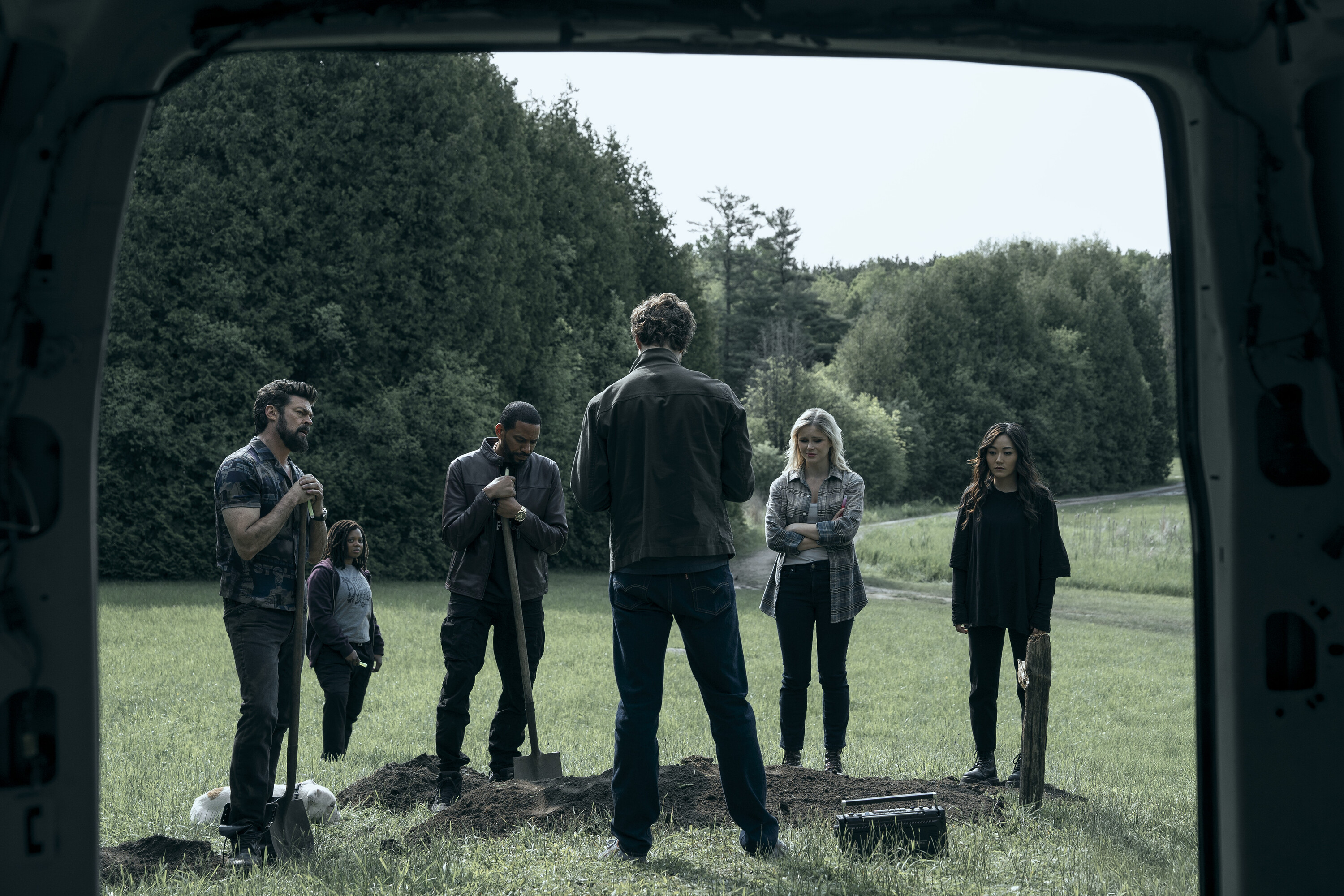
“Life imitates art.” Actually, Oscar Wilde’s entire quote is “life imitates art far more than art imitates life,” but in the case of the recently concluded streaming series “The Boys,” the opposite is no longer the exception to the rule.
When the first installment of “The Boys” graphic novels was published in 2007, the original quote was largely accurate. “Graphic” art was certainly the case, as writer Garth Ennis depicted superhero orgies and incredible violence drawn in detail. As time marched on, “in real life” became uncomfortably close to the originally outlandish premise of a superhero gone apeshit. This is particularly true of the streaming version, which began to align presciently with current events despite having been written and filmed a year or more prior.
Both versions begin with the introduction of Hughie (played by Jack Quaid in the series), who becomes the moral center of “The Boys” universe. His girlfriend is killed by superhero speedster A-Train (Jessie T. Usher), who barrels into her and leaves Hughie holding her severed arms. This tragedy is what leads Hughie to join the Boys, a motley group assembled for the purpose of destroying “the supes.” Alarmed by their increasing dominance and erratic behavior, main character William “Billy” Butcher (Karl Urban) is chosen by the CIA to lead a clandestine operation intended to curtail their antics.
It’s no coincidence that the phrase “the Supes” leaves out the hero part, because they’re anything but. Instead, they’re Bizzaro World versions of Superman, Captain America, the Flash, Aquaman, etc. Their powers are enablers of decadency and narcissism, employed not for the public good but for private depravity.
It’s here that the streaming series begins to diverge from the comics. Both versions retain the Vought Corporation, a conglomerate which creates “V,” a serum giving normal children super powers. Given the sheer amount of print content presented in the 72 issues of the comic series, it was necessary for showrunner Eric Kripke to whittle down the number of characters and ancillary plots.
His storyline focused on the Seven, a Vought Corporation board of Supes, headed by their psychopathic leader Homelander (Antony Starr). He and Butcher are the linchpins of both stories, with Superman-like Homelander personifying absolute power gone absolutely awry. Butcher is his mirror image, initially a normal human, bent on revenge for Homelander’s rape of his wife. Butcher becomes increasingly devious and evil himself, as he looks into the abyss.
The sprawling cast of the graphic novels is reduced considerably and from there the storyline concentrates on the Seven, the Boys, and a few other Supes. Most notable of these is Soldier Boy (Jensen Ackles), a Captain America type and one of the first Vought Supes. His role departs substantially from the comic version, where he is only a minor character. In the streaming series, Soldier Boy becomes an integral cast member despite appearing only in Season 3 and the final, fifth season.
The decision to prominently feature Soldier Boy is one of Kripke’s best decisions. Not only does it lend a critical focus to the series’ narrative, it enabled Kripke to bring on board Ackles, the longtime star of Kripke’s former show “Supernatural.” Fans of that show were pleased to see Supernatural alumni Jared Padalecki and Misha Collins also guest star in Season 5.
Ackles is the perfect embodiment of apostwar-era toxic masculinity, who vacillates between aiding the Boys and helping Homelander, who turns out to be his son. He is both acerbically humorous and terrifyingly amoral, emphasizing the ability of the streaming series to amplify a minor character and employ him as a focal point of the story.
He provides a stopping point between power and madness, unlike his son. Homelander steadily devolves over five seasons, moving from reluctantly playing a corporate “hero” into a descent to total madness. It’s here that the series’ focus on celebrity, power and politics actually pre-dates specific current events in a frightening fashion.
Homelander’s rise to preeminence is fueled by his populistic politics, an “America First” emphasis that disguises his thirst for absolute power. Ultimately, he demands loyalty, obedience, and fealty from his followers. After a “vision,” he sees himself as God, an episode filmed two years ago but aired two days after Trump’s Truth Social post depicting himself as Jesus. An episode which featured a gold statue of Homelander also aired shortly before Trump’s own gold leaf statue was unveiled. You can’t make this stuff up—or can you? “It sucks that you can’t out-satire reality,” said Kripke recently.
The ability of the streaming version to enhance and amplify the relatability of an originally ironic storyline is its biggest asset, along with the powerhouse performances of Urban’s Billy Butcher (“Daddy’s home!”) and most notably Starr’s Homelander. Starr’s ability to portray Homelander as an insecure, terrifying narcissist who somehow manages to occasionally evoke sympathy for his own unbelievably traumatic childhood, is superb.
A nod is due to the exploration of fatherhood and family ties, and the impact of childhood trauma on one’s ability to adequately function as an adult.
Kudos to Kripke, for a superb take on Garth Ennis’ graphic novels.
About the writer
Lori DuVall-Jackson is a Buffalo resident and graduate of Canisius University. Her passions include crime, music, and wildlife conservation. Her columns are published monthly in the My View section of the Buffalo News. Past work includes editorial credit for her contributions to “Charles Burchfield’s Journals-The Poetry of Place,” published by SUNY Press.


Leave a Reply